
Out with the old…
Let’s hear it for SIM cards—the strongest physical link between a telecom service provider and its customers, allowing those providers to (physically) tie a user’s identity to the SIM card being issued.
Traditionally, telcos will collect and verify a new customer’s identity and address information—in person—when issuing the physical SIM card, and with good reason. Not only is in-person identity verification a good way to prevent most forms of fraud, but it’s also a great way to get new customers into a brick-and-mortar store, where they’re more likely to purchase additional products and services.
But there’s a dark side to physical SIMs—two, in fact.
First, thanks to the rise of remote onboarding processes used by banks, insurers, and healthcare providers (to name a few), customers are getting hooked on all-digital processes and becoming increasingly reluctant to visit brick-and-mortar stores. More and more, service providers who won’t offer a remote onboarding and digital identity verification experience risk losing potential customers to the providers who will—especially younger, digital-native customers.
Second, tying a physical SIM card to in-person identity verification is effective at the time of issuance. But, once that customer leaves the store, the chain of trust is incredibly easy to break. One of the most popular forms of fraud today is called a “SIM Swap,” in which a fraudster convinces a telecom provider to mail a “replacement” SIM card to a different address. And, once the fraudster is in possession of that physical SIM card, they don’t need to be in the same room (or even the same country) as a telecom customer to steal their identity information—which is often secured by a one-time-passcode (OTP) delivered through SMS.
Even if the replacement request is legitimate, it means either traveling to the brick-and-mortar store a second time or waiting several days for a snail mail delivery—inconveniences that can have a severe, negative impact on customer satisfaction.
In with the new…
It’s no wonder, then, that the future of telecom is trending towards eSIMs (Embedded Subscriber Identity Modules), soldered directly to a board inside the user’s device and allowing customers to activate a carrier’s cellular plan without having to obtain (and insert) a separate SIM card.
With eSIMs, the onboarding and identity verification process can be fully remote, with no need for a customer to visit a physical store or to fumble around trying to insert a SIM card into their device.
And, unlike traditional SIMs, eSIMs can store multiple operator profiles, which can be remotely updated, extended, or deleted with a Remote SIM Provisioning (RSP) tool.
As more device manufacturers switch to eSIMs (Apple, for one, has hinted the iPhone 14 may come in both eSIM-only and dual-SIM models), telecom carriers are faced with two obstacles.
First, they must effectively integrate their remote identity verification solutions with their eSIM subscription management solution. Second, they must make certain this integrated process can accurately tie the issuance of an eSIM to a real customer’s identity in order to stop potential fraud at the source.
To solve the first challenge, Daon’s remote identity verification web application (IdentityX®) works out of the box, with little integration effort needed, and can be fully customized to match the requirements of any telecom business. To solve the second challenge, IdentityX combines robust document authentication with certified facial liveness biometrics, which can be consumed and stored by the business immediately following a successful verification.
Building a faster, safer user journey
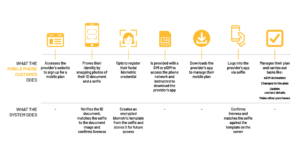
To protect customers and telecom providers both, a highly secure, reliable process for establishing a new user’s identity is essential. At the same time, this process must be as fast, convenient, and frictionless as possible. Here’s how it works in a nutshell:
And here’s how our customer, a worldwide telecom provider, designed their remote identity verification process, powered by Daon’s IdentityX Platform, for both traditional SIMs and eSIMs:
Scroll to top